


Sourdough vs. Sourfaux: 9 key differences to spot
Diving into the Sourdough Craze: What’s Behind the Hype?
Sourdough is becoming increasingly popular. During lockdown many amateur bakers were captivated by the allure of sourdough. With ample time at their disposal and a yearning for a fulfilling activity, enthusiasts were drawn to the methodical and calming process of sourdough making.
Our story began during this period known as the “sourdough renaissance”. Emily, the founder of Good In Bread, fell under the spell of sourdough baking. Cultivating her own starter and crafting loaves with care, she discovered a passion she couldn’t keep to herself. Inspired to share the joy and satisfaction of homemade sourdough, Emily embarked on a mission to spread the love of sourdough through Good In Bread.
We now have a range of authentic sourdough loaves and bagels to choose from, including more niche products such as sourdough ciabatta rolls, sourdough focaccia and sourdough brioche. Furthermore, we also sell sourdough starters and baking kits for fellow baking enthusiasts!


What’s Sourfaux and why does it exist?
Sourdough is continuing to gain popularity with a 3 times resurgence in 2024. (¹) However, as the craze for sourdough continues, it’s also becoming a more competitive market. Many supermarkets are eager to capitalise on the trend by producing their own sourdough loaves. Unfortunately, not all of these offerings are authentic and have been dubbed “sourfaux”. Sourfaux is a term that Chris Young coined in 2015. It describes any product marketed as sourdough but made with yeast and additives, despite not being technically authentic. Indeed, some supermarkets may compromise on quality by adding preservatives, vegetable oils, or other additives. In some cases, they may even use lower-quality ingredients or cut corners in the baking process to reduce production costs.
‘An increasing number of products are being named and marketed using the word “sourdough” that have not been made by a long fermentation process.’ (²)
Chris Young of the Real Bread Campaign
In this blog, we unpick the differences between authentic sourdough and the sourfaux that you find in supermarkets. We’ll uncover its distinct health benefits and artisanal taste, highlighting what makes sourdough a standout choice. We’ll also examine the convenience and affordability of store-bought bread, weighing its merits against the artisanal craftsmanship of homemade loaves.
Whether you’re a bread enthusiast or simply interested in making healthier choices, join us as we navigate the complexities of the bread aisle. Get ready to explore hidden ingredients, find out what sets true sourdough apart and find your favourite loaf!
Can sourdough contain preservatives?
Bakers make traditional sourdough bread with just four ingredients:
- Flour
- Water
- Sourdough starter (which is a combination of flour and water naturally fermented by wild yeast and bacteria)
- Salt
Sourdough should only contain the naturally occurring yeast from a sourdough starter. If yeast is listed in the ingredients, it refers to commercial yeast, which is not used in authentic sourdough.
If you spot yeast, preservatives or additional additives on the ingredient list, it’s probably not the real deal.
The fermentation process, which can take several hours to days, naturally preserves the bread by producing organic acids and other compounds that inhibit the growth of harmful bacteria and mould.
However, certain store-bought options, including loaves from the fresh baked section of supermarkets, often include extra ingredients to enhance shelf life and ensure uniform quality.
These can encompass preservatives, stabilisers, dough conditioners, and enzymes. While these additives serve practical purposes for large-scale production, they can deviate from the simplicity, health benefits and taste of traditional sourdough. To enjoy authentic sourdough, check ingredient lists or visit artisanal bakeries that use traditional methods. We get it—it’s tough to make it to a bakery with a hectic schedule. That’s why Emily, our founder, started Good In Bread: to make sourdough accessible to everyone, no matter where they live or how busy life gets. We deliver authentic sourdough straight to your door.
We’re proud to make our sourdough bread without any additives or preservatives, relying solely on natural fermentation for freshness. Our selection includes sourdough brioche, focaccia, and ciabatta. Our bagels have a hint of yeast (0.02% of the recipe) for a lighter texture; without it, they’d be a bit denser.
Sourdough Labelling: What Does ‘With Sourdough’ Really Mean?
Some companies use the words ‘with sourdough’ on the label. This means they make a normal yeasted loaf, with just a bit of sourdough starter or discard added. However, there is usually such a minimal amount that there won’t be any health benefits and probably very little noticeable difference in the flavour. Companies tend to use this more for marketing motives as sourdough has become a buzzword. It’s important to read labels carefully and understand what you’re getting, especially when it comes to trendy terms like sourdough.
Differences between Sourdough and Sourfaux
When comparing sourdough and “sourfaux” (a term often used to describe mass-produced, imitation sourdough bread), there are several key aspects to consider:
1. Ingredients:
- Sourdough: Typically made with just flour, water, salt and naturally occurring wild yeast and bacteria from a sourdough starter.
- Sourfaux: Often contains commercial yeast, preservatives, vegetable oils, sugars (including barley malt), and other additives. These extra ingredients are added to extend shelf life and enhance texture. Sometimes the ingredients include vinegar to imitate the sour tang of a genuine sourdough.
Check out our Instagram video for more info!

Think about the flour’s quality and how it affects bread taste, your health, and the environment. Since authentic sourdough has few ingredients, flour quality is key. That’s why we use organic regenerative flour in all our loaves. You can read more about this in our blog 5 ways to shop and eat bread sustainably, where we talk about understanding flour and agricultural practices.
2. Fermentation Process:
- Authentic Sourdough: Utilises natural fermentation with wild yeasts and lactobacilli, requiring a longer fermentation period (usually 24 hours).
- Store-Bought “Sourfaux”: May use commercial yeast and faster fermentation methods to reduce production time.
3. Health Benefits:
- Sourdough: The long fermentation process breaks down gluten and phytates, making the bread easier to digest and increasing the bioavailability of nutrients. It typically has a lower glycemic index.
- Sourfaux: May not offer the same digestive benefits or nutrient availability, because bakers either shorten the fermentation process or don’t truly use it.
For more information on the health benefits read the 5 benefits of sourdough.
4. Craft and Quality:
- Sourdough: Crafted by skilled bakers with attention to detail, leading to a unique flavour and texture profile.
- Sourfaux: Produced with an emphasis on uniformity and cost-efficiency, often sacrificing quality and flavour (Sustain UK).
More about this later under key differences between high and low quality sourdough bread.
5. Taste and Texture:
- Sourdough: Characterised by a tangy flavour and a chewy, open crumb with a crisp crust.
- Sourfaux: Often lacks the depth of flavour and the distinctive crumb structure of true sourdough. The taste might be milder and the texture more uniform.
For more information on the taste read the irresistible flavour of sourdough.
6. Environmental Impact:
- Sourdough: Often made locally with minimal packaging, reducing transportation and waste.
- Sourfaux: Mass-produced, which can involve more packaging and transportation, increasing its environmental footprint.
For more information on the environmental impact read 5 ways to shop and eat bread sustainably.
7. Cost:
- Sourdough: Typically more expensive due to the time-intensive process, skilled bakers and quality ingredients.
- Sourfaux: Generally cheaper, produced on a large scale with cost-cutting measures.
8. Labelling and Transparency:
- Authentic Sourdough: Typically clearly labelled with simple, natural ingredients.
- Store-Bought “Sourfaux”: May not always be transparent about the use of additives or the production process, potentially misleading consumers.
9. Local Economy Support:
- Authentic Sourdough: Often sold by local bakeries and small businesses, supporting the local economy and fostering community relationships (Sustain UK).
- Store-Bought “Sourfaux”: Typically sold by large supermarket chains, with profits benefiting larger corporations rather than local enterprises (Sustain UK)

Key Differences Between High-Quality and Low-Quality Sourdough Bread?
Above we have outlined the differences between sourdough and sourfaux. However, even within authentic sourdough, there can be huge differences in quality. When comparing high-quality and low-quality sourdough, several factors come into play that affect the taste, texture, and nutritional value of the bread.
Here are some key things to look at:
Traditional methods
High-quality sourdough bakers often produce smaller batches using traditional methods, reflecting a commitment to artisanal techniques and quality. They hand-shape and slow-ferment the dough, allowing for the development of complex flavors and better digestibility. This process roots itself in ancient baking traditions, ensuring that the bread maintains its authentic character. All of our sourdough is made by hand from start to finish.
On the other hand, manufacturers of low-quality sourdough may mass-produce it using industrial processes.
For example, some store-bought sourdough may use machinery, rather than making it by hand from start to finish. That is why their sourdough loaves all look identical. It is technically sourdough as they don’t use yeast, but it is not exactly authentic and is certainly of a lower quality.
Quality of the flour
The quality of flour is very important as it is the main ingredient in bread. We believe that organic flour is best so use it in all of our breads and in our baking kits. Organic standards impose rigorous criteria ; they ban artificial fertilisers and GMO ingredients while supporting ethical and sustainable farming practices.
Furthermore, a study published in the British Journal of Nutrition found that organic crops and grains are more nutritious, with higher levels of antioxidants. Conventional crops had twice the amount of cadmium than organic crops. This is important as another study indicated that cadmium, a highly toxic heavy metal contaminant, has been linked to kidney failure, bone softening, liver failure, and lung cancer.
Organic crops and grains are more nutritious
The flour in our bread is not only organic but also regenerative. To find out more about the differences between organic and regenerative farming practices read 5 ways to shop and eat bread sustainably.
Furthermore, stone-ground flour is tastier and more nutritious than the regular roller-milled flour found in most sourdough. If you want to learn more about the importance of stone-ground flour, stay updated on our blog as we are currently working on a detailed article about it!
The Real Bread Campaign’s Crusade for Authentic Sourdough
The Real Bread Campaign is an initiative that champions traditional breadmaking and aims to combat false marketing claims related to bread, particularly sourdough. The campaign advocates for transparency and authenticity in bread production, promoting the use of natural ingredients and traditional methods.
The Real Bread campaign has called out major British supermarket chains for labelling their bread as sourdough when it is “sourfaux”. Indeed, in the UK (and some other countries) there is no legal definition of sourdough, craft bakery, or artisan bread, allowing anyone to use those terms to market any loaf they produce.
Supermarket loaves are all very standardised – uniform in shape and colour – highlighting that they’re not artisanal or hand crafted.
The Real Bread Campaign has an Honest Crust Act where they address these issues. We find it particularly shocking how some additives don’t even have to appear on industrial loaf labels. Additionally, there is no legal definition or minimum content requirement for a loaf to be called wholegrain, meaning that a wholegrain loaf could contain just a few grams of wholemeal flour.
Visit the Real Bread Campaign’s website and read their blogs to learn more. Empower yourself to make more informed choices!
Final Thoughts: Embracing Authentic Sourdough
In the battle between sourdough and sourfaux, knowledge is your greatest ally. With the insights provided by the Real Bread Campaign and other reputable sources, you can navigate the world of bread with confidence. Remember, it’s not just about taste; it’s about tradition, authenticity and supporting genuine craftsmanship.
We take immense pride in the authenticity of our sourdough loaves. What sets us apart is our unwavering commitment to quality, ensuring that every loaf exceeds expectations. One way we achieve this is by using stone-ground flour in all our loaves.
In particular, our bestseller, the white country loaf, is exclusively crafted from 100% stone-ground flour, ensuring a superior texture and flavour. But it doesn’t stop there. We’re also dedicated to sustainability and health, which is why the flour we use is not just organic but regenerative as well. Choosing our loaves means indulging in the finest bread while contributing positively to the environment. Furthermore, our authentic sourdough not only offers superior flavour but also helps preserve a time-honoured tradition and supports skilled artisans. So, the next time you reach for a loaf of bread, take a moment to scrutinise the label and savour the satisfaction of knowing you’re indulging in the real deal.
If you want to learn more
If you want to learn more about the differences between sourdough and supermarket bread, read:
- Our blog entitled supermarket vs sourdough.
- Our starter blog includes information on the difference between sourdough and yeasted bread. It’s also a great article if you want to start baking your own sourdough.
- Dr Chris Van Tulleken’s book, Ultra-Processed People: Why Do We All Eat Stuff That Isn’t Food … and Why Can’t We Stop?
- The Guardian’s article on how supermarket sourdough is often sourfaux.
Follow us on Instagram and LinkedIn for all things sourdough.
Furthermore, if you prefer to bake at home rather than buy bread, check out our ready-made starter and baking kits to help you on your sourdough adventure.
Note: if you don’t live in London, you can find our products on Delli.

Loaded Bagel
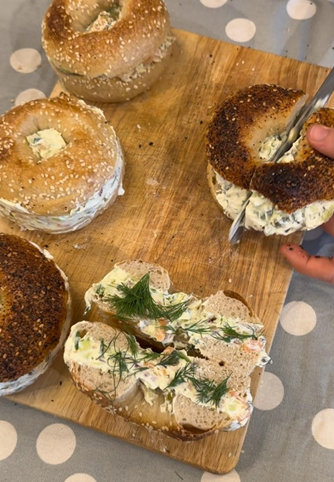
We have a banging bagel recipe coming up for you! A twist on the classic combination of cream cheese and smoked salmon. This upgraded version combines the saltiness of capers and smoked salmon with the creaminess of cheese and avocado. Add some fresh herbs into the mix and the tangy notes from the sourdough bagel and you have yourself a flavour powerhouse.
Get ready to make your jaw work overtime as you bite into the ultimate loaded bagel.
Ingredients
Good In Bread sourdough bagels (plain or everything bagel)
Cream Cheese
Smoked Salmon
Red Onion
Avocado
Cucumbers
Capers
Chives
Dill
Instructions
1. Slice the cucumber, red onion and avocado.
2. Chop the chives & dill and put these aside.
3. Slice a couple of bagels in half (horizontally) and pop them in the toaster.
4. Place several generous dollops of cream cheese onto a chopping board.
5. Add pieces of smoked salmon and capers onto the cream cheese.
6. Add the sliced vegetables from step number 1.
7. Sprinkle on the chopped chives and dill.
8. Chop and mash everything together and blend into a patty shape.
9. Using a spatula, place inside the toasted bagels and slice in half (vertically).
10. If you want, add more fresh dill on the top of the filling like in the photo below.
Savoury Spread Week
To acknowledge the start of Lent and because we love our Savoury Spreads, we’re having a Savoury Spread Week to show off our delicious savoury range. From our Organic Artichoke spread to our Black Olive Spreads, we have a variety to choose from and love them paired with our toasted sourdough and a drizzle of our Mas Amadeo Olive Oil.
We’re giving one lucky winner the chance to get their hands on one jar of our artichoke spread.
How To Enter:
✓ Follow us on Instagram or Subscribe to our Newsletter if you do not have IG.
✓ Tag a friend in the comments and let us know what your favourite savoury spread is (Please email us if you do not have instagram).
✓ Like the photo
*COMPETITION CLOSED*

In Sourdough, We Crust
Hey there, folks! Let’s talk about the marvellous world of Sourdough and its irresistible flexibility; everyone has their own way of savouring those loaves. You’ve got the fresh enthusiasts, tearing off those delightful chunks and dipping them in rich olive oil. Then, there are those who relish the crispy crunch of a toasted sandwich with that delectable crust.
Now, for those who lean towards the crunchier side, you might notice that our loaf’s journey from the oven to your doorstep can slightly soften the crust. But fear not! We want you to know that a softer crust doesn’t mean our bread has lost its magic. We take great care to deliver our loaves within just a few hours of baking, using sealed packaging to keep them fresh for as long as possible.
But hey, we get it. Some of you crave an even crunchier crust! So, here are our top-notch tips to revive that crust just before you eagerly tear it open and indulge. Enjoy!
For a slightly crunchier crust:
- Pre-heat your oven to 190C
- Dab the top of the crust with a bit of water from your hand
- Pop it in for 7-8 minutes depending on your taste.
- Then you can dunk, tear, or spread, and enjoy!
For a charcoaled thicker crust:
- Pre-heat your oven to 210C
- Dab the top of the crust with a bit of water from your hand
- Pop it in for 10-12 minutes depending on your taste.
- Then you can dunk, tear, or spread, and enjoy!
For more options on the best way to store your bread to prevent it going stale, see our Top Tips For Freezing.
Delivery range!
We are currently delivering to all of ENGLAND AND WALES.
All of our London deliveries are completed by bike or electric vehicle, making them emission-free & 100% environmentally friendly! For orders outside of London, we use DHL. We aim to deliver the freshest Sourdough bread possible, direct from our ovens to your doorstep in an eco-friendly way.
Keep your eyes peeled for more post-codes being added soon!


Fruit & Spice ‘Winter Wonderbread’
We’ve been working on something pretty special for the Christmas season, which we hope you’ll love as much as we do.
Our new ‘Winter Wonderbread’ is one of our most unique sourdough loaves, inspired by the traditional German Christmas ‘Stollen’ recipe; made with dried fruits & a subtle blend of festive spices, including cardamom, star anise & vanilla, our Wonderbread is a bit of a showstopper.
Cosy up & get toasty this Winter with our Wonderbread, enjoyed plain or toasted with a bit of butter, this festive treat is really pretty wonderful.
Weight: 675g
Ingredients:
- Stoneground White flour
- Wholewheat flour
- Almond flour
- Pumpkin purée
- Malt
- Raisins
- Apricots
- Cinnamon
- Cardamon
- Star anise
- Nutmeg
- Vanilla
- Coffee
- Rum
- Salt
Good In Bread Pops Up at Shreeji Newsagents
We are very excited to announce that our first Pop-Up takes place this weekend in collaboration with Shreeji News and co-host Laura De Gunzburg from The Artichoke.
To celebrate we’re doing a giveaway, where we’re offering our first five visitors free Sourdough bread goodie bags! To be eligible, please follow the steps below:
2) Message @GoodInBreadUK
3) Stop by our Pop Up on one of the dates listed below (10am-5pm) to collect your goodie bags! We look forward to seeing you all there!
Pop-Up dates listed below:
Sat/Sun 24/25 October
Sat/Sun 31 Oct/1 November
Sat/Sun 7/8 November
Sat/Sun 14/15 November
~
From 10am – 5pm.
Good In Spread
This week we’re all about spreading the loaf, so we’re eager to see your Good In Spread creations.
Everyone loves their toast a different way; at Good in Bread, Jess prefers savoury over sweet, always opting for marmite, whereas Emily stays loyal to salted butter and honey.
Which one are you?
To spread the loaf, we’re encouraging you to DM or email us with your favourite spreads, and in return we’ll send you a free spread of your choice from our selection!
Please note that spreads will only be sent with an accompanying bread purchase (subscriptions are included in this).
*olive oil not included.
Fall-ing in Loaf
This week sees the beginning of the Harvest festival, a month that celebrates the act of gathering the wheat, corn and other crops. The word itself originates from the Old English word Haerfest, which literally translates to Autumn, the season of gathering the food of the land.
For centuries, September and October consisted of gathering the food in time for the cold and dry months ahead; a good harvest ensured a well-fed community for the bleak winter months. At the end of the harvest season, a lavish meal consisting of baked breads, vegetable dishes, meats, tarts and ales were consumed, alongside dancing, singing and much merriment!
Whilst technology and machines advanced, the dependence on the harvest season reduced over each century, yet the significance remained. October is an opportunity to celebrate these old traditions, some of which pre-dated Christianity, as we are all encouraged to focus on seasonal crops and goods that were once a vital part of human survival through these bitter winter months.
Wheat has been a staple part of our diet for centuries, and in turn, so has bread; the humble loaf that is seen at each meal time and feast. We’re proud of our sourdough and the delicious yet nourishing sustenance it provides.

The Overnight Oat ‘Hearty Loaf’
We are proud to present our new Overnight Oat Sourdough ‘Hearty Loaf’. Made from soaked overnight oats, this nutritious and decadent loaf is packed with antioxidants and fibres, providing you with even more healthy nourishment to last you through the day. We love it for breakfast as it pairs just as beautifully with butter and jam as it does with a side of scrambled eggs.
Like all of our Sourdough loaves, it was handcrafted using artisan baking methods, the finest organic flours, natural sourdough leavens and a long cool fermentation. We like to think this gives our breads that unique flavour, aroma and texture.
Ingredients (including allergens):
- Sourdough starter (flour & water)
- Organic stoneground wheat flour
- Organic stoneground wholemeal flour
- Salt
- Water
- Overnight-Soaked Oat flakes
Allergens:
- May also contain traces of other nuts and tree nuts.
Care instructions:
- Pre-sliced: freeze right away in bio-degradable freezer bags. Loaf contains approx 20 slices.
- Unsliced: keep at room temperature in brown kraft bag provided or in linen bag.
Weight: 750g
